SYSTEMATIC THEOLOGY (All 3 Volumes In 1): ADDRESSING THEOLOGICAL TOPICS ONE BY ONE by CHARLES HODGE
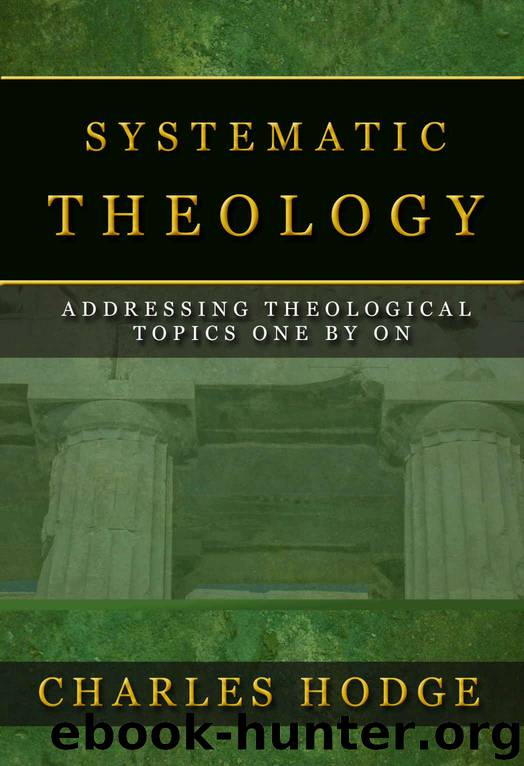
Author:CHARLES HODGE [HODGE, CHARLES]
Language: eng
Format: azw3
Published: 2014-06-30T04:00:00+00:00
478
Expiation and Propitiation.
Expiation and propitiation are correlative terms. The sinner, or his guilt is expiated; God, or justice, is propitiated. Guilt must, from the nature of God, be visited with punishment, which is the expression of God’s disapprobation of sin. Guilt is expiated, in the Scriptural representation, covered, by satisfaction, i.e., by vicarious punishment. God is thereby rendered propitious, i.e., it is now consistent with his nature to pardon and bless the sinner. Propitious and loving are not convertible terms. God is love. He loved us while sinners, and before satisfaction was rendered. Satisfaction or expiation does not awaken love in the divine mind. It only renders it consistent with his justice that God should exercise his love towards transgressors of his law. This is expressed by the Greek verb ἱכάףךןלבי, propitium facio. “To reconcile oneself to any one by expiation.” That by which this reconciliation is effected is called ἱכבףלόע or ἱכבףפήסיןם. The effect produced is that God is ἵכבןע. God is good to all, full of pity and compassion to all, even to the chief of sinners. But he is ἵכבןע only to those for whose sins an expiation has been made. That is, according to the Old Testament usage, “whose sins are covered.” “To cover sin,” ???????, is never used to express the idea of moral purification, or sanctification, but always that of expiation. The means by which sin is said to be covered, is not reformation, or good works, but blood, vicarious satisfaction. This in Hebrew is ?????, that which covers. The combination of these two ideas led the LXX. to call the cover of the ark ἱכבףפήסיןם, that which covered or shut out the testimony of the law against the sins of the people, and thus rendered God propitious. It was an ἱכבףפήסיןם, however, only because sprinkled with blood. Men may philosophize about the nature of God, his relation to his creatures, and the terms on which He will forgive sin, and they may never arrive at a satisfactory conclusion; but when the question is simply, What do the Scriptures teach on this subject? the matter is comparatively easy. In the Old Testament and in the New, God is declared to be just, in the sense that his nature demands the punishment of sin; that therefore there can be no remission without such punishment, vicarious or personal; that the plan of salvation symbolically and typically exhibited in the Mosaic institution, expounded in the prophets, and clearly and variously taught in the New Testament, involves the substitution of the incarnate Son of God in the place of sinners9who assumed their obligation to satisfy divine justice, and that He did in fact make a full and perfect satisfaction for sin, bearing the penalty of the law in their stead; all this is so plain and undeniable that it has always been the faith of the Church and is admitted to be the doctrine of the Scriptures by the leading Rationalists of our day. It has been denied
Download
This site does not store any files on its server. We only index and link to content provided by other sites. Please contact the content providers to delete copyright contents if any and email us, we'll remove relevant links or contents immediately.
The Five People You Meet in Heaven by Mitch Albom(3550)
The Secret Power of Speaking God's Word by Joyce Meyer(3165)
Real Sex by Lauren F. Winner(3006)
Name Book, The: Over 10,000 Names--Their Meanings, Origins, and Spiritual Significance by Astoria Dorothy(2974)
The Holy Spirit by Billy Graham(2941)
0041152001443424520 .pdf by Unknown(2842)
How The Mind Works by Steven Pinker(2811)
ESV Study Bible by Crossway(2773)
Ancient Worlds by Michael Scott(2680)
Churchill by Paul Johnson(2576)
The Meaning of the Library by unknow(2563)
The ESV Study Bible by Crossway Bibles(2546)
The Gnostic Gospels by Pagels Elaine(2522)
MOSES THE EGYPTIAN by Jan Assmann(2411)
Jesus by Paul Johnson(2351)
City of Stairs by Robert Jackson Bennett(2339)
The Complete Dead Sea Scrolls in English (7th Edition) (Penguin Classics) by Geza Vermes(2269)
The Nativity by Geza Vermes(2226)
Ancient Near Eastern Thought and the Old Testament by John H. Walton(2220)
